

Taking 5 minutes before you hit record to go through these 9 points can change the whole feel of an episode and help you and your guest start off on the same page:
1: The podcast guest agreement
Ideally this document will be sent and signed before the guest signs into the recording room. But don’t hit record until this is done.
My friend Jaime at Contracts Market says that a podcast release form is important to have in place so that you have the rights that you need to do what you want with your content. What if a former guest wants you to edit or take down their episode after it’s been published? Or what if you monetize the show down the line and your guest wants additional compensation or royalties? Thankfully, Contracts Market has a Podcast Guest Agreement that sets this all out in clear language and makes sure you’re legally covered.
2: Name pronunciation
If there’s ANY chance you might not know how to pronounce your guest’s name, it’s always better to get clear on it BEFORE you hit record.
Rumie recommends you simply say, “‘I want to make sure that I say your name correctly. Could you pronounce your name for me, please?’ And avoid saying things like ‘your name is so exotic/strange/complicated!‘ or ‘I’m really trying — it’s just that your name is really difficult!’“
3: Sound check — mic, headphones, and room noise
To get the best sound quality, your guest should be using some type of microphone for recording — they shouldn’t be speaking directly into their computer. They should ideally also be using headphones of some kind so that their mic doesn’t pick up the sound of your voice coming through the speakers.
(Your guest should know this ahead of time — this info should be shared along with the guest release form, any questionnaires you need filled out, and all other information your guest needs ahead of time.
If you don’t already have a podcast prep email that you send to your guests, click here for our template.)
Most recording platforms have some kind of mic and camera check that happens before the guest enters the room, like Riverside:
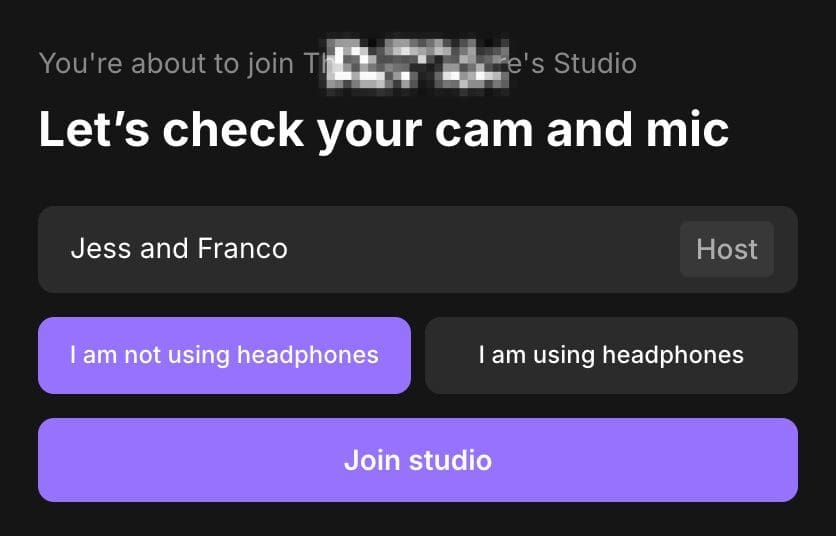
Ask your guest to make sure their phone is on silent, and to close any doors to the room they’re in so that you can keep the ambient noise (and distractions) to a minimum.
4. Off-limit topics
A quick “is there anything you’d rather we don’t get into today?” takes ten seconds and prevents a lot of awkward editing later. Better to know upfront.
5. What topic(s) the guest wants to cover
When you bring another entrepreneur onto your pod, there’s a really great chance that they have something cool going on, or they have a launch coming up. So make sure to check in and see if there’s anything specific that they want you to touch on so that you can make sure the convo gets there somehow. This is great for you, too, because they’ll probably be super stoked while talking about whatever it is, and that always makes for a super engaging episode.
6. A quick rundown of the format
Depending on how many podcasts your guest has been on, they might feel a little nervous prior to hitting record. We find that giving a quick rundown of what’s going to happen helps make people feel more relaxed and comfortable. Saying something like…
“Just so you know how this is going to go, when I hit record, I’m going to start off by giving a quick introduction to you and an overview of what we’re going to chat about, and then we’re just going to have a fun conversation. I have some questions I want to ask you but I also let the conversation go where it naturally goes! We’ll talk for about 45 minutes, and then I’ll wrap up with a quick outro.”
^^ And of course, customize that to the way you run your pod.
7. Prioritize audio listeners over video
If anything comes up that your guest wants to reference visually — something on their desk, something in your background, a pet — ask them to describe it out loud, too. If you’re recording the podcast as a video, your guests will likely default to a video-first mindset, so say something like “Even though we’re recording video today, I prioritize the audio experience for my listeners, so you’ll notice that I will describe anything visual. So if you or I hold anything up, or I comment on your shirt or your background, I will describe it so the listeners can picture it. Feel free to do the same!”
8. Your editing policy
Some podcasts release any and every word said from start to finish, no editing. Others allow for editing and let guests give another answer if they feel it wasn’t their best, or if they’ve said something they didn’t mean to say. Whatever your policy is, make sure you let your guest know.
9. Your cursing policy
We can’t tell you the number of times we’ve heard guests ask, “Am I allowed to swear on this podcast?” It’s always a good idea to let your guest know your cursing policy ahead of time, ESPECIALLY if you prefer that guests don’t swear — there’s a good chance that one will slip out of your guest’s mouth, and then you’ll have to edit it out and have this convo mid-pod. Not fun!
This might feel like a lot, but realistically, this should take you about 5 minutes and it sets up everything that follows. The guests who feel the most at ease on a recording are almost always the ones who knew exactly what they’ were’re walking into — and that’s entirely within your control as the host.


